Last Updated 03-26-2020 2:56 pm
Ometeotl is the Nahua name for the dual creative force at the source of all existence — the sacred union of complementary energies from which everything is born. Ancestors understood Ometeotl as the supreme creative force that is beyond our ability to fully encapsulate or describe.
Ometeotl is also the most popular name by which most contemporary Mexicas refer to what many would call God. But given the negative and misinterpreted connotations we have come to associate with the Judeo-Christian-dominated term “God,” we would be misleading ourselves in understanding the profound beauty of our spirituality by simply referring to Ometeotl as (a) God.
Perhaps Ometeotl may be considered “a grand field or force that creates,” a profound (divine) process personified. Make no mistake, though — Ometeotl should not be reduced to a mere static science concept lacking spirit. Consider the profound intelligence and creativity we attribute to ourselves and our civilizations; to think the creative force that gives us all life is a mere insentient configuration is pretty arrogant.
While Ometeotl may be personified by the word Creator, we must also be careful not to think of “he/she/it/them” as a single person or entity. Yes, it can be considered a single entity, in the sense that we acknowledge that everything is connected. Single yet multiple at the same time. Contradiction? Yes — that’s Ometeotl too. This is also probably where the idea of “Gods” or polytheism arises from. More often, the ancestors would mention Tlaloc, Ehekatl, Quetzalcoatl, Huehueteotl, and others. So when Ometeotl was mentioned, it would not take place in a way that made Ometeotl the center of the “religion.”
Rather than exhausting ourselves on anthropomorphic explanations about “God” or trying to contain the “ever-becoming” within an absolute definition, we focus instead on the fact that we are referring to a force that is grand, mysterious, and beautiful.
Ometeotl means the complementary force of creation in Nahuatl, formed from ome (two, duality) and teotl (creative energy). The name is often translated literally as “Two-God” or “Dual God,” but Nahuatl is a symbolic, poetic, and technical language, and its words should not always be taken literally.
Nahuatl words carry layers of meaning and symbolism. Many “Mexica” academics insist on single, rigid definitions and associations. Doing this, we can easily choke the life and essence out of a word — and that’s not how we roll here. The following breakdown helps grasp the essence of Ometeotl:
|
OME |
Two, Balance, Duality, Reflection |
|
TEOTL |
Generating force/movement |
|
OMETEOTL |
Creator Mother & Father; “May What Is Dual Unite to Create” |
As you can see, many English words are needed to convey a single Indigenous word — and they still barely manage to create a respectable understanding.
The debate over whether Ometeotl existed centers on the scholar Miguel León-Portilla, who popularized the concept in his books La Filosofía Náhuatl (1956) and Aztec Thought and Culture. Critics argue the specific word “Ometeotl” does not appear in pre-conquest primary sources and was assembled from later, colonial-era materials.
The sharpest critique comes from Richard Haly’s 1992 article “Bare Bones: Rethinking Mesoamerican Divinity.” Haly and those who follow him make several arguments worth understanding honestly:
The word is absent from primary sources. Critics say Ometeotl does not appear in the Florentine Codex, the Cantares Mexicanos, or other pre-conquest documents in the unified form León-Portilla described.
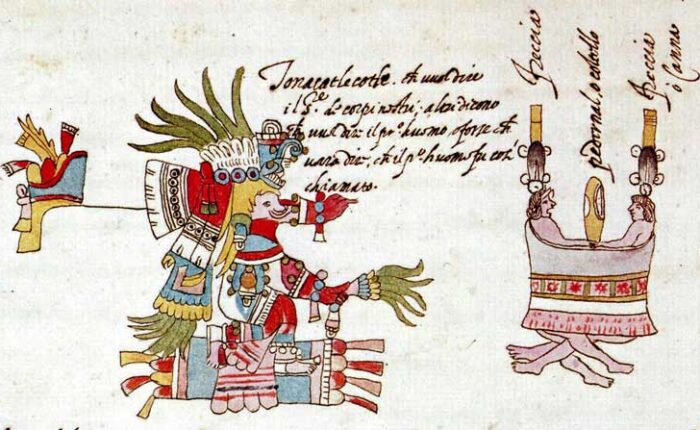
Some readings may be mistranslations. A term in the Historia Tolteca-Chichimeca reads ayometeotl (relating to maguey) rather than a “god of duality,” and a figure in the Codex Ríos (Vaticanus A) labeled in the thirteenth heaven, Omeyocan, may depict Tonacateuctli under European interpretation.
The “bone lord” confusion. A related name, Omiteuctli (omitl, bone + teuctli, lord), refers to a bone deity connected to Huitzilopochtli — close in spelling to Ometeotl, but different in meaning.
Here is where we part ways with the debate. The scholars and so-called Indigenous thinkers who orient themselves within Western academia can spend their careers litigating whether a single word appears in a single manuscript. That is their terrain, not ours. We are community-building practitioners oriented toward practical healing — and while there are credible arguments for the word’s existence, our concern is not its spelling. Our concern is stirring our people away from the linear, colonial, Christian frameworks that have held them back and toward our Indigenous spiritual inheritance
The Ometeotl debate is really an argument over a word, not over the underlying spiritual science. Every serious party to the discussion — León-Portilla, his critics, and philosophers of Nahua thought — agrees that teotl, duality, balance, and complementary creative forces are genuinely present in Mesoamerican philosophy.
Look closely at what the critics concede. They agree Teotl is real. They agree that duality (ome) is real. They agree that balance and the pairing of complementary forces run all through Nahua cosmology. What they contest is whether one specific compound word appears, spelled a certain way, in a surviving colonial manuscript. That is a debate about the label on the jar — not about the medicine inside it.
Nobody in this argument claims our ancestors lacked a concept of generative duality. So we don’t need to go to war over the spelling of a word to know that the principle it points to — that creation arises from the union of complementary energies — is ancient, documented, and alive. As we’ve said before, itis best not to waste energy on intellectual battles, which are mostly ego-driven. Invest that energy instead in living the teachings.
Ometeotl lives beyond the colonial archive, in ceremony, language, and the lived relationship our people maintain with the sacred. A spiritual science is neither real nor unreal because a colonizer wrote a particular word down in 1540. That standard — the primary-source document as the only arbiter of truth — is itself a Western, linear way of knowing.
Explaining Ometeotl becomes very difficult when we try to fit our living spiritual experience into static Western conceptual forms. Western (linear) word-concepts don’t have the capacity to give our Indigenous (circular) understanding the environment it needs to reflect its depth. It gets even more troublesome when non-spiritual people try to explain spiritual understandings, centering only material knowledge derived from Western epistemology instead of a spiritually balanced knowledge derived from Indigenous-centered methodology.
This is the heart of it. The critics’ arguments deal only with the word “Ometeotl” itself — not with the spirit of what Ometeotl encompasses. Because the word allegedly cannot be traced to a primary source, they dismiss the entire understanding. But the qualities we attribute to Ometeotl — duality, balance, generation — face little serious dispute about their existence and prevalence in Nahua and Mexica spiritual sciences. The archive is one witness. Ceremony, elders, and lived practice are witnesses too, and older ones.
Ometecuhtli and Omecihuatl are the masculine and feminine faces of Ometeotl’s duality — the Lord and Lady of the Two, understood to dwell in Omeyocan, the thirteenth heaven and “place of duality.” They are not two separate gods on thrones. They are one complementary movement expressed as two, the way inhaling and exhaling are one breath.
This is why the framing of “Creator Mother and Father” matters. The masculine and feminine here are cosmic principles in balance, not genders in the human social sense. Where a linear worldview would rank one above the other, the circular worldview holds them as equal and interdependent — neither complete without the other. That balance is the teaching. Omeyocan is less a location in the sky than the condition of perfect equilibrium from which creation continually pours.
Nahuatl holds many names for Creator/Creation, each carrying a distinct nuance rather than a single fixed definition. Just as you might call a person by their name, and also by intimate names like “brother” or “junior,” our ancestors addressed the sacred in warm, personal, relational ways — where a Western worldview would coldly reduce it to a scientific process.
|
Ayac Oquipic |
Nobody Gave Him/Her/Them Being or Form |
|
In Tona In Tote |
Our Mother, Our Father |
|
Ipalnemohuani |
The One in Whom We Live and Move and Have Our Being; the Giver of Life |
|
Ilhuicahua in Tlalticpaque |
The One Who Makes the Heavens and the Earth |
|
Yocoyani |
Creator of All That Exists |
|
In Tloque in Nahuaque |
The Lord of the far and the near |
These “Gods” and deities can be understood as personifications of profound processes of the infinite universe and creation — cosmic relatives. From a practical stance, I mostly use the name Ometeotl when praying or putting a query out to the “Great Mystery.” Since the dominant nation in my family is P’urhépecha from Michoacán, I may also use the sacred name Kuricueri (coo-di-ka-we-di). You will find other Creator/Creation aspect names, each with a distinct nuance.
Ometeotl is used as an affirmation and word of power in Native circles, spoken to align yourself with wisdom or vision that has been put into motion. For example, when an elder speaks wisdom that resonates, you might nod and say “Ometeotl” in agreement, aligning yourself with the words.
Before and after speaking, you invoke the sacred by saying Ometeotl:
Before you speak: “Ometeotl, Tlazocamati…”
After you speak: “…Ometeotl.”
It is common to say Ometeotl before and after formally addressing people. Using the word when you speak communicates sincerity and focus. Saying Ometeotl when you finish indicates not only that you are concluding your words, but that you are invoking the sacred as witness and co-manifestor to your word.
Obviously, linguistics, semantics, politics, and even ego disputes can make all of this more complicated. But rather than getting lost in intellectual battles, invest your time and energy in creating meaningful words in your Nahuatl language — to express your world and lift your people. Become the living experience by which we bring the power and beauty of our ancestors into our lives through the way we live. Your direct experience supersedes everything else.
Ometeotl means the complementary force of creation in Nahuatl, combining ome (two, duality) with teotl (creative energy). The name is often translated as “Two-God” or “Dual God,” but it points to the union of complementary energies from which all creation arises, not a single deity.
Ometeotl as a spiritual principle of duality and balance is well documented in Nahua thought, though scholars debate whether the specific word appears in pre-conquest primary sources. The critique, led by Richard Haly, targets the word’s origin, not the underlying concept of complementary creative forces, which faces little serious dispute.
Ometeotl is better understood as a creative force or sacred process than as a god in the Western sense. Contemporary Mexicas use the name for what others might call God, but Ometeotl describes an interconnected, dual creative energy rather than a single anthropomorphic deity separate from creation.
Omeyocan is the thirteenth and highest heaven in Mexica cosmology, known as the “place of duality.” Omeyocan is understood as the dwelling of Ometeotl’s dual aspects, Ometecuhtli and Omecihuatl, and represents the condition of perfect balance from which creation continually flows.
Ometecuhtli and Omecihuatl are the masculine and feminine faces of Ometeotl’s duality, often called the Lord and Lady of the Two. They are not two separate gods but one complementary movement expressed as two, embodying the balance of cosmic energies rather than human gender.
People say Ometeotl as an affirmation and word of power to align themselves with wisdom or sacred vision. Spoken before and after addressing others, the word communicates sincerity and invokes the sacred as witness and co-manifestor to one’s words.